The wind eased overnight so it was just a matter of waiting for the water to clear up a bit. We checked the jetty first thing but the swell was still up and vis about 1/2m.
Checked again in the afternoon and conditions had just improved enough to jump in. Swell was still enough to make entry a little tricky with a bulky camera setup but vis had improved to 3m. Lucky we did dive because this would be our only break in the weather for the whole 4 days.
The trip from the dirt carpark to the entry platform is much easier with trolleys. It's shorter than it used to be walking right out to the end of the old pier and could be done without trolleys if you don't have heavy camera gear. We locked the trolleys and camera bag to the pier railings with a bike cable lock, but the fishos seemed friendly enough. It gets very crowded on weekends.
From the entry platform a row of metal stakes lead west straight across to the old pier in about 6m. Another row heads out north west toward the end of the old pier then does a dog-leg back to meet the main pier. The stakes must be about 5m apart, we couldn't see from one to the next.
The area between the two rows of stakes is called Leafy Gardens, there are 5 resident leafies here.
Unfortunately a recent head cold had left me with an unsuspected clogged up frontal sinus. Below 5m I was getting a bad headache above my right eye. This was the first time ever for me, very frustrating. I then spotted 2 leafy sea dragons down at 6m but was unable to get down to photograph them. I flashed Bruce with my strobes and there was much rejoicing, although he wondered why I wasn't down there shooting. I think he interpreted my headache signals as clenched fist type celebrations.
Eventually I managed to get down the extra 1m by going very slowly, or it might have been the adrenaline masking the pain, and started shooting dragons. What an experience, they are the most bizarre and beautiful creatures. They swim very slowly rocking up and down, often swimming in unison with a mate. In fact the rocking motion is how I spotted them initially, and they are slightly brighter yellow than the weed.
We stayed down for over an hour finding one more seadragon, a few big spider crabs and a little cuttle.
While we were down the wind and swell had increased making the exit a little too exciting but nothing could dampen the exhilaration of finding these spectacular and rare seadragons. Leafies are only found in a limited stretch of southern Australia, nowhere else in the world.
We were looking forward to subsequent dives with better conditions but sadly the wind picked up and prevented any more diving over the next 2 days. We could have headed over to Victor Harbour and calmer water but the vis wouldn't have been any better.
Here's a 4 min video of the trip
One issue with diving at Rapid Bay is that there are no dive shops on the Fleurieu Peninsula. The closest dive shop is Southern Diving 70min drive north at Christies Beach. All the closer dive shops have closed down. So we took 3 tanks each and intended to do the 2 1/2 hr round trip for fills after dive 3. Maybe next time.
On our last walk along the jetty we came across an instructor and student from NB Scuba in McLaren Vale. He told us these were the worst conditions he'd seen in 6 months! He also said he has a compressor at home and does fills and is closer than Christies Beach. Good to know.
It was interesting to see the dive instructors wearing shark shields, maybe it's a workplace safety requirement.
Mixing two hobbies, UW photography and Kite Aerial photography, results in aerial photos of dive sites.
On a recent dive to Popes Eye in Jan's boat I decided to sling in the KAP bag just incase the wind was nice. I was a little concerned about disturbing the gannets and kite line tangles. Shouldn't have worried as we were the only boat at the site and the gannets are such good flyers and they tended to come in just skimming the water surface.
I used the Pilot 2m2 parafoil which stuffs into a small bag and the GoPro in its waterproof housing. Wind was just right, light and steady. Next time I'll aim to capture the whole rock circle.
Underwater the blue-throat wrasse were up for some posing and the water was clear enough for some decent shots.
Now my dive site requirements are calm clear water with just enough wind to lift a KAP rig. Unfortunately all subsequent dives have been in perfect diving weather with no wind at all.
A major problem with underwater video is camera movement. Keeping still enough to prevent your audience getting seasick is not easy and for macro it's impossible.
So here's a basic idea for a tripod. Using my existing 8" strobe arms, clamps and a handle post attached to three Sea and Sea ball adaptors from Mr Leung of ebay again.
Here's a video of the first test in 2m vis and 10c temp. Hurry up summer!
To fit the balls to the handle bolts 2 adapter holes were enlarged to 8mm. Another hole was drilled in the tray to attach the third ball.
OK I was wrong about the D7000 not fitting in the D80 housing. It actually does fit. Must have not cleared one of the controls at my first attempt.
Front and rear control dials, +/- EV, On/Off and focus lock work but there is no access to video switch. Some of the buttons to the left of the screen would be useable with a small reshaping of the rubber push button ends.
It's a tight fit with the camera pushing hard against something at the front so I would strongly advise a test in fresh water before jumping into the sea.
Winter in southern Aus is giant cuttle mating season. These normally secretive relatives of squid and octopus become all outgoing and inquisitive.
They will often follow divers around and even occasionally come in for a hand shake, like in this video.
I was shooting stills at the time then quickly switched to video when the cuttle showed interest. With a bit more time i would have done a manual white balance and used -1.0 ev in Aperture priority for better colour and exposure.
One thing I was busting to try was split levels or under/over shots with the D7000. I had big hopes for the low noise and fast AF.
With my D80 noise is quite obvious in the underwater half at 400iso after some exposure increase adjustment.
The AF on the D7000 is brilliant. In these river splits I was blindly locking focus on something underwater and shooting a few shots while lifting the camera up with great results.
During overcast periods I bumped up to 800iso and although noise is visible in the smooth underwater subjects it can only be seen at 100%.
Here's a shot of Pt Lonsdale on a magic calm sunny day, converted to B&W from a Raw file.
First underwater test today so naturally the conditions were poor with silty 3m vis at St Leonards.
First issue was fitting the camera into the housing. The right side triangular neck strap ring tends to flip up and sit on top of the camera and won't fit under the AE lock shaft in the housing. It must be flipped down to fit the mounted camera into the housing. It also flipped up during the dive which meant I couldn't pull the camera out of the housing until it was jiggled down. I may cut it off or stick it down somehow.
Underwater impressions.....the bigger 3" screen is excellent and live view is definitely usable but AF slows down and is more fussy. In normal use the AF is much faster and more accurate than the D80, a delight.
Setting PRE or custom white balance is easy and works well. It's not something I have ever used before but it gave nice results for the timelapse photos using my glove palm as a grey card.
The intervalometer will be a feature I use a lot being addicted to timelapse now, apologies to any future dive buddies. Will have to sort out DOF and AF better next time.
Video worked well, but I don't know which AF mode to use yet. I was using AF-S but will try a continuous mode next time.
Maybe tried too much this dive, actually this will be an issue, this camera can do too much. I can see myself looking for still, video and timelapse subjects on all dives in the future.
I marvel at the ability of housing maunufacturers to make all those tiny camera buttons, levers and and control wheels available in the housing.
The D7000 Ikelite housing gives access to everything except the DOF preview button and dioptre adjustment. There's even a button for popping up and adjusting the internal flash, which doesn't make a lot of sense because the flash can't pop up enough to work.
The movie record button/lever has been moved all the way out to the right side of the housing and is easily operated by thumb without letting go of the handle. This makes movie recording smoother than with the camera itself.
There is enough space around the camera, especially on the right side, to fit my leak alarms.
You do need to retract some controls when inserting the mounted camera to make sure it sits in place.
The view through the viewfinder seems to include more of the frame than my D80 housing, but I'll have to check that underwater, hopefully tomorrow.
When it arrived the first test was to see what worked in my D80 Ikelite housing. Nothing was the answer, couldn't even close the housing with the D7000 inside. The camera body is just too thick, front to back, to fit at all. I was always going to buy a new housing but in the pursuit of knowledge I had to try. I have since ordered an Ikelite housing from Digital Diver for $1672 delivered. It arrives in a few days.
Why Ikelite? Well, I have all the ports, like the see-through acrylic and extra space for tweaking and I can afford them. Other housings like Nauticam, Subal and Aquatica may be smaller and sleeker but they are also thousands more expensive and wouldn't improve my photos.
One drawback with an Ike housing is that you can't pop the camera flash up and use fibre optic flash sync, but there are stirrings in my little grey cells that may overcome this. A future project.
Initial impressions of the camera.
The larger 3" screen is wonderful. The INFO button which fills the review screen with all the camera settings will be nice underwater for ageing eyes. I'm starting to find the top LCD screen difficult to read.
AF during video will be an issue. SLR lenses make lots of noise while autofocusing and that is all perfectly recorded by the mic, so you either have to ditch the audio track or prevent continuous AF for video. AF-S will be the way to go for me. You start and stop recording with the dedicated video button but you can tap the shutter button at any time to refocus.
I'll be leaving the "sticky buttons" or "Release button to use dial" option (f7 in the control menu) permanently on. That means you tap and release a button, like ISO or WB, and then make changes with the control dial. Much easier in a housing than trying to use both hands.
f6 in the control menu is another must for me. That's the "Menus and Playback OFF" setting, which means you can make A and S changes with the dials while image review is still on. With my D80 I was always trying to make quick exposure changes after a shot but would actually be flipping to the next image, very frustrating.
There are 2 user settings available on the mode dial which are used to save sets of commonly required settings. I have set U1 for intervalometer recording where I want the image size small, and U2 for RAW underwater with WB 5260K. Then I can leave the camera on jpeg fine and Auto WB for normal use.
The intervalometer is a blast. You can choose the shooting interval, say 1 shot every 5 sec, and how many shots up to 999. Using Quicktime 7 Pro you can turn the image sequence into a timelapse movie at frame rates ranging from 10sec/frame to 60frames/sec. Here's one of me painting our front fence. 3hrs in 17sec.
A playback frame rate of 25fps would give a 40sec movie from 999 frames.
AF for stills seems very fast and the shutter action seems lightning fast too. I keep expecting the second clunk of the mirror returning but it has already happened.
That's what has exited me so far. I'll chat about image quality and functionality underwater in the next instalment.
I bought myself one of these recently released beauties as soon as the price dropped in Aus. The D7000 comes highly recommended by some serious underwater photographers and I felt it was a worthwhile upgrade from my D80.
Here are some of the features that attracted me.
Full 1080p video with continuous autofocus. Don't know how effective that AF will be, I suspect it will be far from perfect and I'll be using it as single AF rather than continuous.
Live view, looking forward to trying it underwater.
Very fast AF for still shots (not live view), I'm expecting this to be great underwater.
14bit RAW which apparently means much smoother sunburst rendition.
Startlingly low noise at higher ISOs, which will be good for my split levels at 400ISO.
Intervalometer for time-lapse recording. This will be fun underwater and above.
2 SD card slots, for backup or overflow or separating jpegs and RAWs
3" screen and 100% viewfinder, both bigger than the D80.
More on how it all works in real life in the next post.
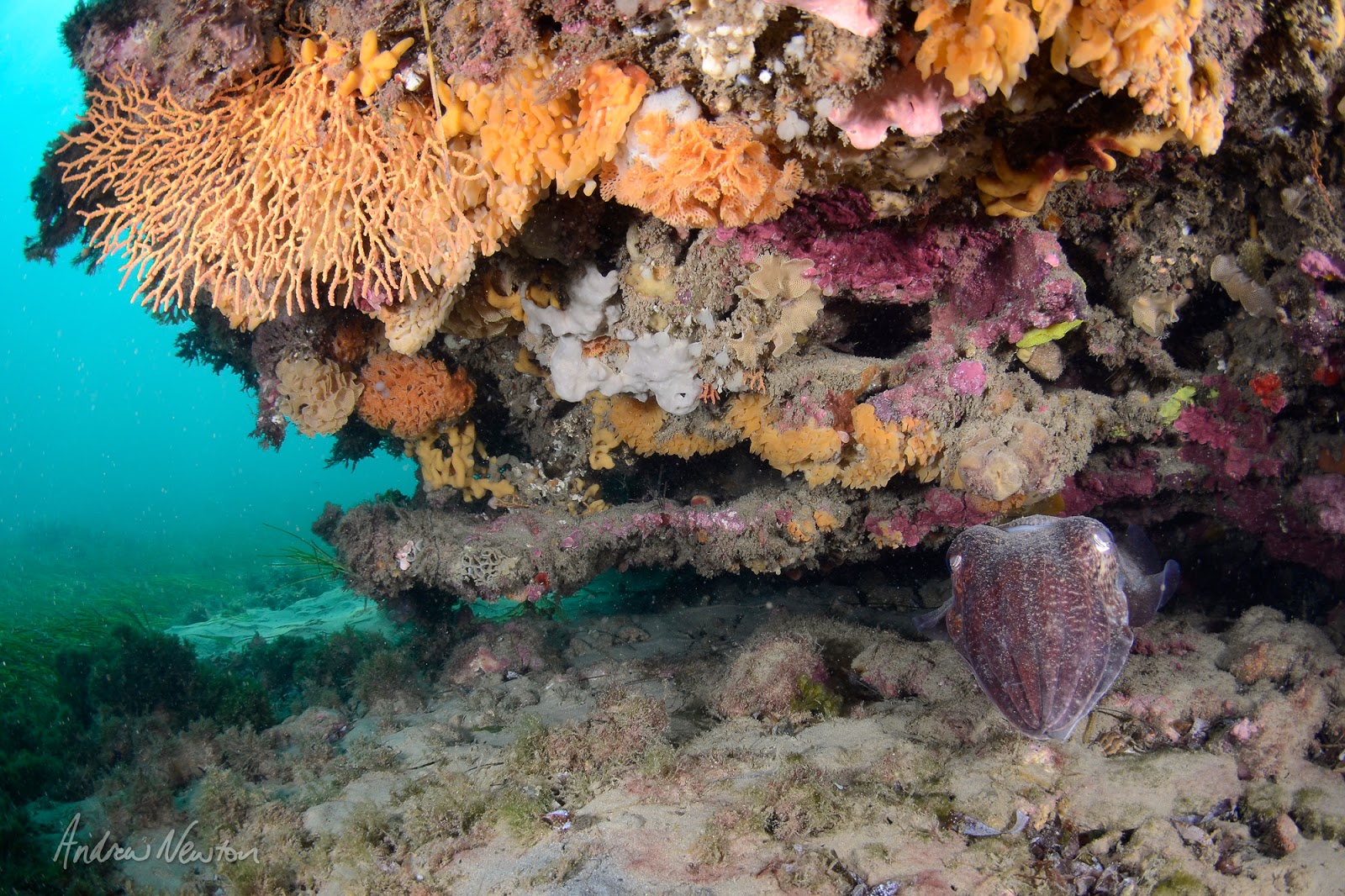 Cottage Reef is a great shore dive halfway between Queenscliff and Pt Lonsdale. The reef is about 50m off shore with max depth of 8m.


